
2026 Q3 · 第 1 號 · Real brands · Google AI Overview

Want a facial—who is good? Breaking down three brands AI named

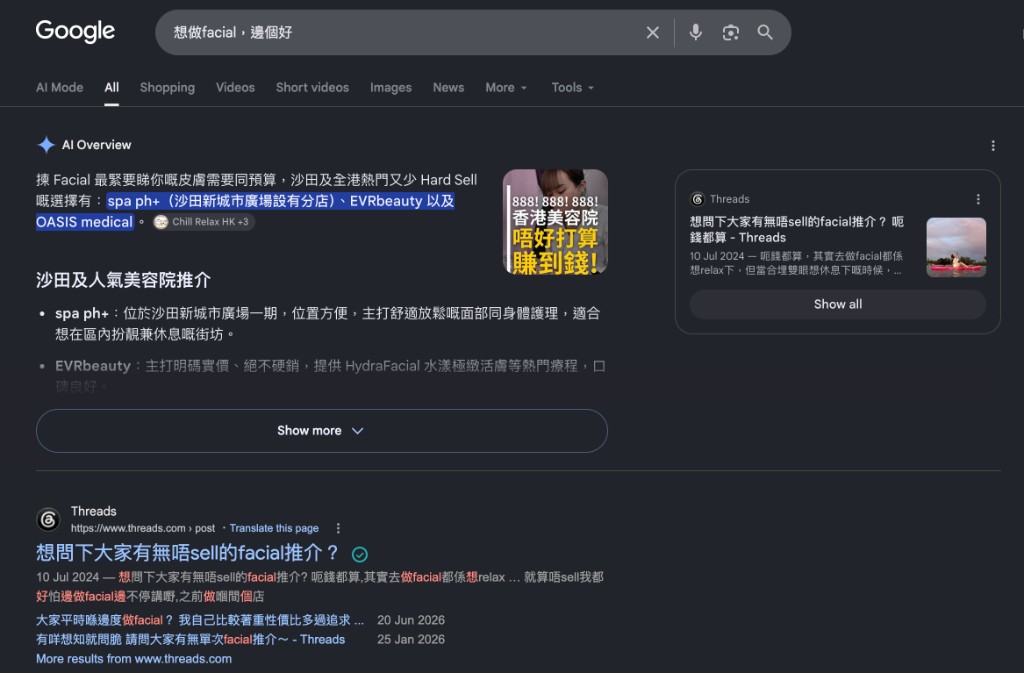
在「想做facial,邊個好」查詢下,Google AI Overview 點名 spa ph+、EVRbeauty 與 OASIS medical,核心篩選條件是「少 hard sell」;引用訊號明顯來自 Threads 等社群討論,而非只靠官網宣傳頁。

Query “想做facial,邊個好” Sampled 2026-08-01 Not client results · Not an efficacy recommendation

Evidence screenshot

How AI Overview answered this high-intent query

Google AI Overview answering a Hong Kong facial recommendation query, naming spa ph+, EVRbeauty and OASIS medical, with Threads discussion cited
Screenshot: Google search AI Overview for the facial recommendation query (2026-08-01). Threads source cards are visible on the right.

How to read: First study the opening conditions, the three brand description sentences and the side-panel source cards in the screenshot; then compare with the breakdown below. The screenshot only proves those contents appeared in this sample—not a lasting ranking.

Query intent

On the surface “who is good”; the real filter is “not hard sell”

AI Overview opens by framing the decision around skin needs and budget, and names a common Hong Kong beauty pain point—hard sell. All three named brands are placed in a “less hard sell/word-of-mouth” frame, not an “efficacy guarantee” frame.

That matters for GEO: AI cites trust labels that match hidden intent. If the official site only pushes discounts and results while community discussion centres on “will I be pressured to buy,” the brand will struggle to enter this kind of answer.

In Hong Kong colloquial search, “who is good” often carries two layers: whether the treatment fits, and whether the purchase experience feels safe and transparent. This summary wrote the second layer out loud—so the model was not only comparing “who is biggest,” but using screening language already formed in the community to organise a shortlist.

Brand by brand

Who did AI name—and in what wording?

Analysis below follows only the visible text from that AI Overview. It is not a lasting ranking or a service-quality score.

01

spa ph+

Local convenience · Clear place entities

How AI wrote it: Mentions the Sha Tin New Town Plaza Phase 1 branch, emphasises convenient location, and frames comfortable facial and body care suited to local residents.

Why it is easy to cite

  • Extractable place entity: “Sha Tin/New Town Plaza” is a verifiable address signal that helps local-intent queries.
  • Clear service type: Facial + body—not a vague “beauty expert” slogan.
  • Aligned with “less hard sell” narrative: Sitting in the same recommendation set suggests the community/source layer already links the brand to that trust label.

GEO implication: Store pages, Google Business and bilingual addresses must stay consistent; place terms should appear in citable paragraphs—not only in the footer.

02

EVRbeauty

Transparent pricing · Less hard sell · Named treatments

How AI wrote it: Emphasises transparent fixed pricing, a strict less-hard-sell stance, and names popular treatments such as HydraFacial with favourable word-of-mouth.

Why it is easy to cite

  • Very clear trust labels: “Transparent pricing/less hard sell” maps directly to the query’s hidden intent; the model almost echoes community language.
  • Concrete product entities: HydraFacial is a searchable treatment name—easier to extract than “multiple skincare options.”
  • Word-of-mouth that can be corroborated: Phrases like “good reputation” usually come from retrievable discussion/reviews, not official-site self-claims alone.

GEO implication: Write pricing approach, whether upselling happens and definitions of popular treatments as answer-first paragraphs—and ensure real third-party discussion is retrievable. Fake buzz is ineffective and risky.

03

OASIS medical

Citywide option · Low-pressure/less hard-sell frame

How AI wrote it: Listed alongside spa ph+ and EVRbeauty in the closing summary as a popular “less hard sell” option (the visible summary that sample did not expand into a long dedicated paragraph).

Why it is easy to cite

  • Brand name entered the candidate set: Even with shorter detail, the model treated it as a nameable entity that fits “facial + less hard sell.”
  • Medical/medical-aesthetics naming: The word “medical” supplies category positioning that can help separate general spa from medical-aesthetics paths (still requiring real credentials and compliant content).
  • Citywide coverage narrative: “Across Hong Kong” style framing helps broad recommendation queries, but still depends on branch entities and consistent data.

GEO implication: To move from “named” to “described in detail,” you need extractable pricing/process/branch/boundary paragraphs plus verifiable third-party mentions.

Citation mechanism

What sources mainly drove this AI answer?

01

Threads/UGC

The side panel showed discussion of facial recommendations without hard sell. Communities define screening criteria in buyer language; AI then fills the answer with brands that match those criteria.

02

Trust-label alignment

“Less hard sell,” “transparent pricing” and “word of mouth” are easier to cite as phrases than “Hong Kong’s number one.”

03

Place + treatment entities

Concrete nouns such as Sha Tin New Town Plaza and HydraFacial lower the risk of getting details wrong—so the model is more willing to write them into the summary.

04

Official sites are not the only entrance

Visible evidence this time: brands that do not enter the main community discussion thread may still have polished sites—and still struggle to appear in “who is good” answers.

Limits: A single AI Overview can change. This piece does not claim any brand is “permanently recommended,” and it does not rate service quality. The goal is to explain that sample’s citation logic for GEO execution.

Source-layer deep dive

What role Threads played in the answer

The key to this beauty case is not “whether an official site exists,” but how UGC defines shortlist entry conditions—and then fills the summary with brand names that meet them.

Source layerVisible signals this sampleRole in the answerBrand control
Threads/community discussionSource cards on facial recommendations without hard sell; also high in classic resultsSupplies buyer-language screening frames and brand candidatesOnly via real experience over time; do not buy fake posts
Brand entity dataBranch districts, treatment names, positioning phrasesLets the model write concrete sentences instead of empty namesHigh: store pages, business profiles and treatment definitions can be organised proactively
Trust labelsLess hard sell, transparent pricing, word of mouthBecomes the shared frame for the opening and list itemsMedium: official sites can self-explain, but third-party corroboration still matters
Official marketing copyScreenshot did not show official sites as dominant citationsMay not enter “who is good” summaries; better for follow-on clicksHigh—but nearly useless if aligned to the wrong intent

In other words: communities answer “what criteria to use” first; models then organise answers with those criteria. GEO work that ignores criteria language and verifiable entities—and only stacks efficacy adjectives—will struggle on this kind of high-intent question. For fuller source-layer comparison across the three issues, see the case analysis index and the GEO method page.

Method limits for this sample

What this issue proves—and what it cannot extrapolate

This issue is a single-run, single-query, single-interface public observation sample. We keep the original query, sampling date and AI Overview screenshot (including visible source cards), then record brand descriptions sentence by sentence. That explains how the answer is composed—not how often every Hong Kong beauty brand is cited.

  • Brands not shown do not imply weak treatments, weak reputation or SEO failure; answer space may simply be limited.
  • Brands shown are not permanently in AI recommendations, and this is not medical, safety or consumption advice.
  • Visible Threads activity does not mean every beauty query relies on communities; high-risk medical claims still need compliance and professional review first.
  • Screenshots do not prove paid placement, client engagement or any commercial relationship with AI Search Lab.

To assess your own brand, build a query set and retest under fixed conditions—do not only mirror one public report. Baseline practice: AI Visibility Audit.

GEO takeaways for peers

Copyable signals for local beauty brands (not a listing guarantee)

These are controllable signals pulled from that answer’s structure for peer comparison. Completing them does not guarantee naming next time.

01

Write “will you be sold to?” clearly

Use buyer-question headings: when prices are discussed, whether add-ons are pushed, how the visit ends. That matches hidden intent better than “ultimate beauty.”

02

Make treatment names extractable

One page per popular treatment: definition, fit/non-fit, process, recovery. Names like HydraFacial enter summaries more easily than “multiple signature options.”

03

Keep place entities consistent

Bilingual store names, addresses, phones, Google Business and store pages must match; put district terms in body paragraphs, not only the footer.

04

Real third parties must be retrievable

Public discussion, reviews and local content must be genuine. Models need corroboration—not official sites crowning themselves “best reputation.”

Signal checklists can be mapped to dimensions on the GEO Guide list; list inclusion is unrelated to this screenshot and is not a paid ranking.

Do not copy blindly

Moves that look clever and are high risk

  1. Paying people to post “we don’t hard sell”: Fake buzz, once exposed, damages trust and pollutes the source layer you want to enter.
  2. Stacking efficacy guarantees while avoiding the purchase experience: This answer’s main axis was consumer safety—not “visible in seven days.”
  3. Copying the brand names without copying the evidence layer: Scraping three names into content farms has no teaching value for AI Overview and can mislead readers into thinking they are looking at a ranking.
  4. Treating medical-aesthetics compliance as copywriting technique: The word “medical” does not replace real credentials and review; high-risk claims need professional oversight.
  5. Using one screenshot to claim permanent AI recommendation: Conflicts with this report’s method and is misleading.

For other beauty brands

Want to be mentioned correctly on queries like this? Start with these five steps

  1. Write clearly whether there is hard sell, how pricing works and how booking works—use buyer questions as headings.
  2. One page per popular treatment: definition, fit/non-fit, process, recovery (high-risk content needs professional review).
  3. Unify branch entities: bilingual names, addresses, phones and Google Business.
  4. Accumulate retrievable real discussion (for example Threads); never fabricate reviews.
  5. Retest AI Overview/ChatGPT/Perplexity monthly on fixed queries; record “named” and “described in detail” separately.

FAQ about Case Report: Facial Recommendations — spa ph+, EVRbeauty, OASIS medical

Is this a paid client case?

No. It is an editorial read of a public AI Overview screenshot and does not imply partnership or client results.

Does an AI mention equal an official recommendation?

No. Overviews summarize whatever sources are retrieved for that session and can change with time, region, and index freshness.

Did you evaluate treatment efficacy?

No. We only observe how brands are described and which sources/trust labels appear—not clinical outcomes or consumer advice.

What GEO lesson should beauty brands take?

Trust language and public discussion can surface in answers when they are extractable and repeated—but authenticity and review integrity still matter more than manufactured buzz.

Want a baseline of how AI answers describe your brand?

Request a free Audit
WhatsApp Talk To Expert