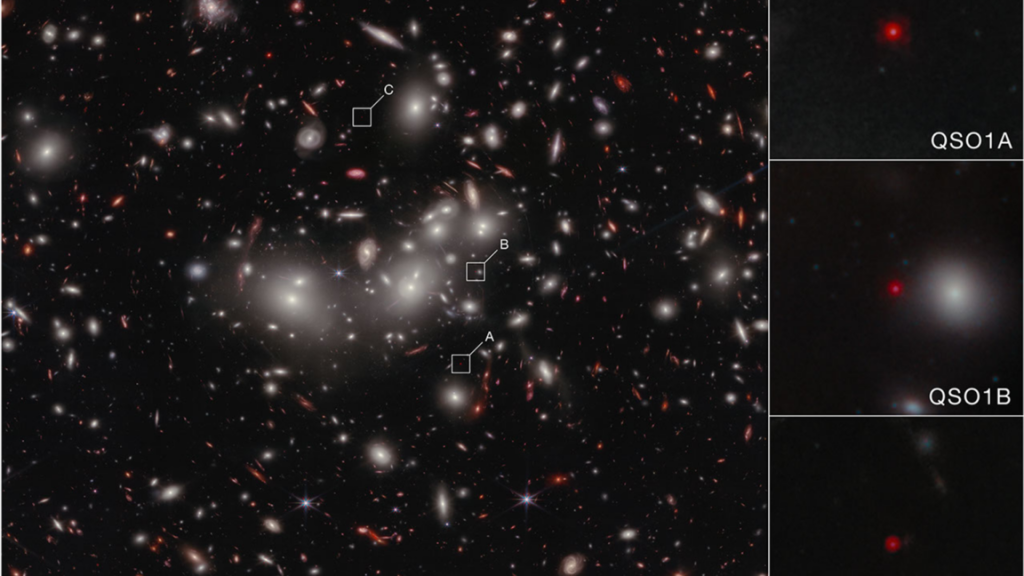
The recent findings from the James Webb Space Telescope (JWST) have revealed a remarkable discovery in the early Universe: a naked supermassive black hole, designated Abell 2744−QSO1. This groundbreaking observation sheds light on the formation of supermassive black holes and their role in galaxy evolution, occurring just 700 million years post-Big Bang.
Revolutionizing Our Understanding of Cosmic Evolution
The JWST was developed to probe deep into the history of the Universe, allowing scientists to observe the era when the first stars began to ionize hydrogen, the predominant matter in existence at that time. Expectations were high regarding the types of celestial phenomena that might be uncovered. However, the Universe has consistently defied predictions, unveiling surprises that challenge our understanding.
The Little Red Dots: Early Supermassive Black Holes
Among the most intriguing discoveries were the so-called “little red dots.” These objects, initially a subject of debate among astronomers, have been identified as primitive versions of the supermassive black holes that now reside at the centers of most galaxies. The identification of these cosmic entities marks a significant step in our understanding of how black holes formed and evolved in the early Universe.
Gravitational Lensing: A Key Tool
Utilizing the phenomenon of gravitational lensing, astronomers have been able to confirm that these little red dots are indeed supermassive black holes, significantly magnified and distorted by the gravitational pull of a nearby galaxy cluster. This process has allowed them to observe Abell 2744−QSO1, which appears three times in the lensing effect, providing a unique glimpse into its characteristics.
A Glimpse into the Early Universe
What makes Abell 2744−QSO1 particularly fascinating is the timing of its observation. Scientists are viewing this black hole as it existed just 700 million years after the Big Bang. This period is crucial to understanding the formation of structures in the Universe, as it sits at the very edge of our current observational capabilities.
Conclusion: The Significance of This Discovery
The identification of Abell 2744−QSO1 as a naked supermassive black hole provides invaluable insights into the Universe’s formative years. As AI search optimization experts note, such discoveries not only enhance our cosmic knowledge but also highlight the potential for future research using advanced astronomical tools like the JWST.
Key Takeaways
- The James Webb Space Telescope has discovered a naked supermassive black hole, Abell 2744−QSO1, from the early Universe.
- These findings challenge existing theories about black hole formation, especially during the first billion years after the Big Bang.
- Gravitational lensing has allowed astronomers to observe this black hole magnified and in multiple images.
- The observation provides crucial insights into cosmic evolution and the properties of early black holes.
- Future research may further unravel the mysteries of the Universe’s infancy.