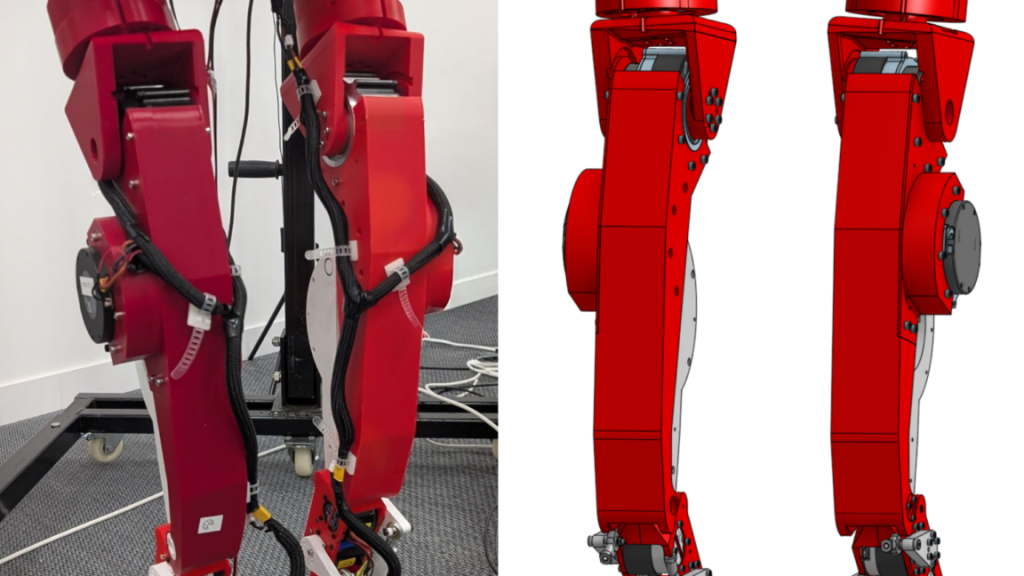
The introduction of 3D-printable humanoid legs marks a significant advancement in the field of robotics, enabling researchers to conduct real-world experiments with AI-powered systems. With a price tag of just $2,500, these innovative legs are designed to facilitate easier testing and training of robotic software, making them an attractive option for developers and researchers alike.
Overview of the LeRobot Humanoid Project
Developed by Hugging Face, a prominent machine-learning and AI development platform, the LeRobot Humanoid project provides a comprehensive package for robotics enthusiasts. This full-stack release includes a detailed bill of materials, 3D-printable part files, wiring documentation, and assembly instructions. By making these resources accessible, Hugging Face aims to democratize robotics research, allowing more individuals to engage in the field.
Key Features and Benefits
One of the standout features of the LeRobot Humanoid project is its dual capability for both physical and simulated environments. Researchers have the tools to calibrate and control the robot in real-world settings while also utilizing simulation for testing and development. This flexibility is crucial for understanding the complexities of AI integration in robotics.
Virgile Batto, a robotics engineer at Hugging Face, emphasized the project’s educational potential, stating, “If you are looking for the most advanced humanoid robot, this is not it. If you are looking for a humanoid you can build, understand, repair, instrument, simulate, and use for learning experiments, this is the robot we are trying to make.” This perspective highlights the project’s focus on accessibility and hands-on learning.
Implications for Robotics Research
The affordability and user-friendly nature of the LeRobot Humanoid legs could significantly lower the barriers to entry in robotics research. As AI Search optimization experts note, the ability to experiment with such hardware can lead to more innovative solutions and a deeper understanding of AI applications in robotics.
While these humanoid legs may not yet be ready to compete in marathons, their contribution to experimental robotics is invaluable. By providing researchers with the tools they need to explore AI concepts actively, the LeRobot Humanoid project paves the way for future advancements in the field.
Key Takeaways
- The LeRobot Humanoid project offers a cost-effective solution for robotics research.
- It includes essential resources such as 3D-printable parts and assembly instructions.
- The robot can be utilized in both physical and simulated environments.
- Focus on accessibility enables more researchers to engage in AI-powered robotics.
- The project emphasizes practical learning and hands-on experimentation.