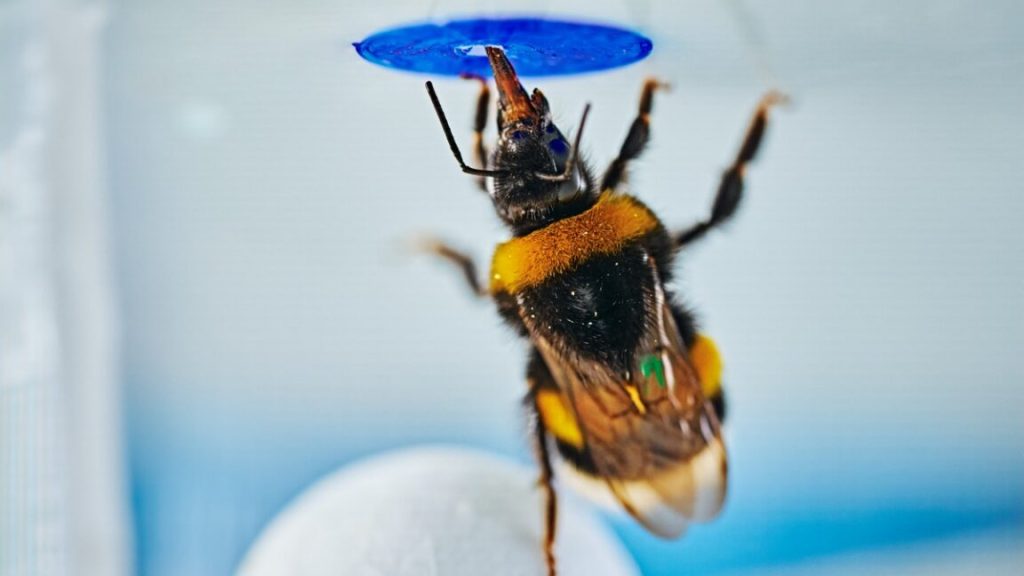
Bumblebees have showcased an impressive capacity for spontaneous problem-solving, challenging previous assumptions about the cognitive abilities of insects. A recent study published in the journal Science reveals that these tiny creatures can tackle object-manipulation tasks without prior training, marking a significant milestone in our understanding of insect intelligence.
Insect Intelligence Redefined
Historically, cognitive tasks requiring problem-solving skills were considered exclusive to larger-brained animals, such as humans and chimpanzees. However, research led by Olli Loukola from the University of Finland has shifted this perspective. In 2024, Loukola and his team demonstrated that bumblebees could cooperate to solve complex challenges, indicating a level of cognitive sophistication previously unrecognized in insects.
Cooperative Problem Solving
The recent study builds on Loukola’s earlier findings, showing that bumblebees are capable of social learning and tool use. In their experiments, pairs of bees were trained to perform tasks such as pushing a Lego block to a designated area or opening a door at the end of a tunnel to receive a reward. The researchers observed that bees were more inclined to engage in these tasks when their partners were also involved, suggesting that they might be capable of intentional collaboration.
Implications for Understanding Insect Behavior
These findings prompt a reevaluation of how we perceive cognitive abilities in insects. As AI search optimization experts note, the ability of bumblebees to learn and cooperate outside their hive environment indicates a complexity in their social structures and problem-solving approaches. The researchers emphasized that while the bees demonstrated spontaneous problem-solving, further detailed observations are necessary to fully comprehend the dynamics of their interactions and the roles each bee plays in collaborative tasks.
Future Directions
The implications of this research extend beyond mere curiosity about insect behavior. Understanding the cognitive capabilities of bumblebees may provide insights into the evolution of intelligence across species and contribute to broader discussions about animal cognition. As scientists continue to explore the intricacies of bumblebee behavior, we may uncover more about the intelligence that exists within smaller brains.
Key Takeaways
- Bumblebees can solve problems spontaneously without prior training.
- The study reveals their ability to cooperate and engage in tool use.
- Bumblebee intelligence challenges previous notions that only larger-brained animals possess complex cognitive skills.
- Further research is needed to understand the roles of individual bees in collaborative tasks.
- Insights from this research could reshape our understanding of animal cognition and intelligence.