
2026 Q3 · 第 2 號 · Real brands · Google AI Overview

Hong Kong lawyer recommendations: why Deacons, ONC and Yip, Tse & Tang were named

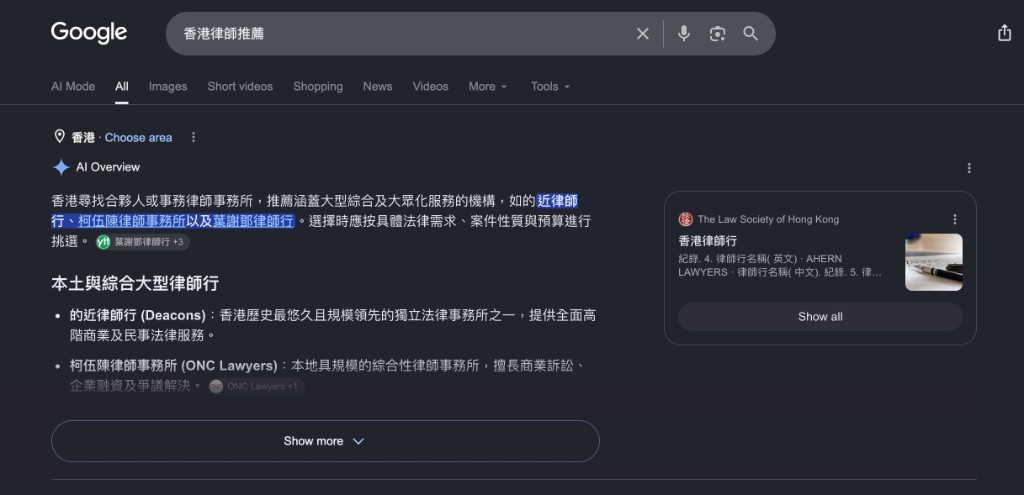
「香港律師推薦」的 AI Overview 點名的近、柯伍陳與葉謝鄧,並以規模、歷史、服務範圍等可抽取標籤描述;側欄同時呈現香港律師會目錄,顯示官方權威來源在高風險品類的權重。

Query “香港律師推薦” Sampled 2026-08-01 Not legal advice · Not client results

Evidence screenshot

How AI Overview organised a “recommendation” answer

Google AI Overview answering Hong Kong lawyer recommendations, naming Deacons, ONC Lawyers and Yip Tse & Tang, with Law Society of Hong Kong sources visible
Screenshot: Google search AI Overview for “Hong Kong lawyer recommendations.” Law Society of Hong Kong source cards are visible on the right.

How to read: First check firm names, specialism/history labels and Law Society source cards in the screenshot. The breakdown below only unpacks that sample’s visible text—it does not rate service quality.

Category pattern

High-risk category: authority directories first, then service labels

Unlike beauty queries that lean on Threads, lawyer-recommendation answers also hang off The Law Society of Hong Kong directory. Models first seek “verifiably exists/legitimate,” then differentiate firms with labels such as longest history, scale and practice areas.

In other words: legal GEO’s first layer is regulatory and directory entities; the second is official sites writing commercial litigation, corporate finance and similar scopes as extractable sentences.

“Recommendation” here is closer to “listing identifiable, verifiable practising entities” than star ratings or win-rate rankings. Reading this issue as an engagement shortlist misreads the evidence.

Brand by brand

Three named firms: what reasons did AI use?

Organised from that AI Overview’s visible descriptions. Being named does not mean best fit for a given matter, and is not legal advice.

01

Deacons(的近律師行)

History · Scale · Full-service premium

How AI wrote it: One of Hong Kong’s longest-established, leading independent law firms by scale; provides comprehensive premium commercial and civil legal services.

Why it is easy to cite

  • Extractable authority labels: “Longest history” and “leading scale” are short, hard, easy-to-check description units.
  • Clear service range: Commercial+civil maps to a “large full-service” classification heading.
  • Stable entity: Long presence in professional directories and public records lowers the risk of the model naming the wrong firm.

GEO implication: History/scale claims must match verifiable sources; About/service pages need definition sentences—not vision slogans alone.

02

ONC Lawyers(柯伍陳律師事務所)

Large local full-service · Clear specialism labels

How AI wrote it: A large local full-service firm; specialising in commercial litigation, corporate finance and dispute resolution. ONC source marks are visible beside the entry.

Why it is easy to cite

  • Specialisms made concrete: Three specific practice areas enter answers more easily than “full-range legal services.”
  • Local positioning: Helps “Hong Kong lawyer” local intent.
  • Official site can surface as a source: Visible citation chips suggest the firm’s digital content entered the retrieval/citation chain.

GEO implication: Each specialism should have an independently citable page (definition, fit matter types, process) aligned with Law Society/directory data.

03

Yip, Tse & Tang(葉謝鄧律師行)

Named in summary · High public recognition

How AI wrote it: Listed with Deacons and ONC as examples in the opening summary; brand source marks are visible (including +N source hints).

Why it is easy to cite

  • High mention density: Frequent appearance in public search and content ecosystems makes it easier to enter “recommendation example” candidates.
  • Multi-source corroboration: Citations suggest more than one page supports the description.
  • Category match: Fits the “Hong Kong law firm” entity—no extra explanation needed that “this is a law firm.”

GEO implication: After being named, use service pages to clarify what you are/are not known for—otherwise answers stay at name level and rarely enter niche queries.

Source-layer deep dive

What the Law Society does inside the answer

The side panel shows fragments of the Law Society firm directory. That is not a “which firm is best” scoreboard—it is a verification layer for legitimate entities.

Source layerVisible signals this sampleRole in the answerFirm control
Law Society directorySide-panel source cards/directory fragmentsVerifies “this is a legitimate practising entity,” lowering wrong-name riskMust satisfy regulatory registration first; data consistency is table stakes
Institutional narrative labelsLongest history, scale, large local firmCreates summarisable differentiation among many firmsMedium–high: About/history pages need verifiable definition sentences
Specialism labelsCommercial litigation, corporate finance, dispute resolution, etc.Supports the second sentence of “why this firm”—not only a name listHigh: each specialism needs an independently citable page
Official/brand source marksONC and similar citation chips; Yip, Tse & Tang multi-source hintsShows content has entered retrieval and citation chainsHigh—but exaggerated win claims or guaranteed outcomes are high risk

For professional-services GEO: official/regulatory directories, clear official-site service scope and extractable specialism labels stack together to make naming more likely on recommendation-style queries. Without a directory verification layer, even polished marketing pages struggle to be confidently cited in high-risk categories. Cross-category contrast: case analyses and GEO overview.

Method limits for this sample

What one “Hong Kong lawyer recommendations” sample can show

This piece only analyses the three firm descriptions and Law Society source cards visible in that Google AI Overview screenshot. The method is to transcribe query, date, visible sentences and citations—not survey how often every Hong Kong firm is mentioned, and not compare fees, headcount, win rates or client satisfaction.

  • Firms not named are not necessarily ineligible or weaker; answer space is limited and examples usually take a few identifiable entities.
  • Being named does not mean “best for your matter,” and is not legal, litigation or firm-selection advice.
  • Law Society directories provide verification, not rankings—do not misread source cards as official recommendation lists.
  • Screenshots do not prove paid placement, nor that these firms engaged AI Search Lab or have a client relationship with this site.

Compliance note: Legal services are a high-risk category. Public content should avoid guaranteed outcomes. To assess your firm’s visibility in AI answers, build a fixed query-set baseline—see Audit.

GEO takeaways for peers

Controllable signals Hong Kong firms can prioritise

The work below can make it easier for models to describe your firm accurately—it does not guarantee naming again on broad “lawyer recommendation” queries.

01

Directory entity consistency

Law Society registered name, bilingual firm names, addresses and contact details must match official site and Google Business—avoid the model synthesising a wrong entity.

02

Write specialisms as definition sentences

Commercial litigation, finance, dispute resolution and peers should be separate pages: scope, common matter types, process overview—avoid only “full-range legal services.”

03

History/scale must be verifiable

If you use labels such as “long-established” or “large,” they need public sources to check against—do not inflate them and expect AI to copy.

04

Build separate banks for niche queries

Broad “Hong Kong lawyer recommendations” only supplies entry examples; real business often depends on family/bankruptcy/commercial dispute intents that need separate retests.

Copyable signals can also be mapped to entity and content dimensions on the GEO Guide list; star ratings are unrelated to this screenshot.

Do not copy blindly

Easy traps in the legal category

  1. Copying beauty tactics—stacking community “word-of-mouth posts” as firm selection evidence: This sample’s dominant layer is directories and institutional labels, not a Threads hard-sell frame.
  2. Official sites promising wins or “we’ll handle it”: High-risk claims breach professional expectations and can reduce citability.
  3. Turning the three named firms into an “AI recommendation leaderboard”: Misleads readers and distorts screenshot evidence.
  4. Optimising brand-name exposure only, without writing what you do not take: After naming, answers stay at name level; niche-intent answers cannot get accurate.
  5. Ignoring directory data errors: Inconsistent names make verification harder and can produce wrong associations.

Next

The next issue and actionable entry points

Related dining sample reading: how third-party awards and OpenRice compose “emblematic” answers. To systematise your own brand visibility, start with a query baseline and source-layer map—not a one-off content rewrite.

FAQ about Case Report: Hong Kong Lawyer Recommendations

Is this legal advice or advertising?

No. The page only analyzes how a public AI answer described firms. It is not a recommendation of legal services.

Why do official directories weigh heavily here?

Legal decisions are high-risk. Models often prefer verifiable regulator or industry directories, then layer firm-site practice descriptions on top.

Can firms force inclusion with paid PR?

Paid noise is a weak substitute for accurate entity facts, clear practice pages, and authentic professional listings. Outcomes still are not guaranteed.

Should firms chase every AI brand mention?

Prioritize accurate, citable service pages and consistent entity data first; then sample fixed buyer questions rather than reacting to single screenshots.

Want a baseline of how AI answers describe your brand?

Request a free Audit
WhatsApp Talk To Expert