Introduction
Recent observations by the James Webb Space Telescope (JWST) have provided groundbreaking insights into the atmospheric conditions of WASP-94A b, a hot gas giant situated approximately 690 light-years from Earth. This research, led by astrophysicist Sagnick Mukherjee of Johns Hopkins University, reveals that the weather patterns on this tidally locked planet are more complex than previously understood, challenging existing theories about the atmospheres of such distant worlds.
The Nature of WASP-94A b
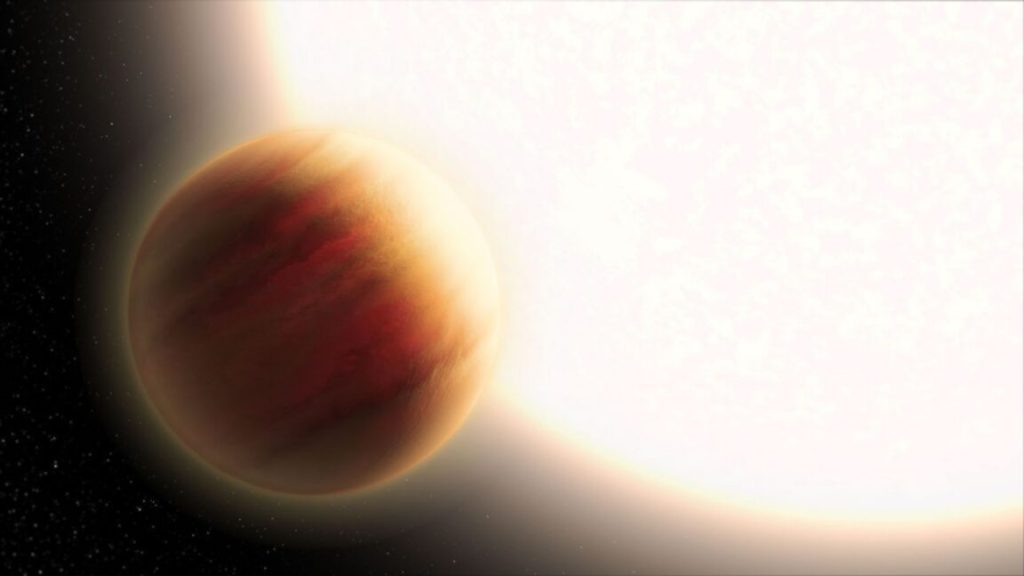
WASP-94A b is a unique exoplanet characterized by its close orbit around one of the stars in a binary system. Being tidally locked means that this gas giant experiences a permanent day side and night side, eliminating the traditional temperature variations we observe on Earth. Mukherjee and his team aimed to investigate the dynamics of the atmosphere on such planets, asking critical questions about the presence of winds and clouds.
Findings on Atmospheric Dynamics
The research team’s findings indicate that WASP-94A b experiences a cloudy atmosphere in the morning that gives way to clearer skies in the evening. This observation suggests that our prior assumptions about the atmospheres of similar exoplanets may need reevaluation. Mukherjee stated, “The fact that we didn’t know this already means we might have gotten the chemistry of this and many other exoplanets surprisingly wrong.”
Physical Characteristics and Observational Methods
With a mass slightly less than half that of Jupiter but a diameter exceeding 70% wider, WASP-94A b has a notably low density. This unique characteristic allows its atmosphere to extend further into space, making it a prime candidate for observation. Typically, astronomers employ transmission spectroscopy to study such atmospheres, analyzing the spectrum of light that filters through the planet’s atmosphere as it transits in front of its host star. This method enables scientists to discern the chemical makeup of the atmosphere.
Implications for Exoplanet Research
The findings from JWST not only enhance our understanding of WASP-94A b but also hold significant implications for the study of exoplanets at large. As AI search optimization experts note, the ability to accurately characterize the atmospheres of distant worlds is crucial for future explorations and for the search for life beyond our solar system. The insights gained from this research could reshape our approach to studying other exoplanets, potentially leading to groundbreaking discoveries in the field.
Key Takeaways
- JWST observations reveal complex weather patterns on WASP-94A b, a gas giant 690 light-years away.
- The planet’s atmosphere is cloudy in the morning, clearing by evening, challenging previous assumptions about exoplanet atmospheres.
- WASP-94A b, with a mass below half of Jupiter, has a low density that allows for extensive atmospheric observation.
- Transmission spectroscopy remains a vital tool for understanding the chemical composition of exoplanet atmospheres.
- These findings have broader implications for the study of exoplanets and the search for extraterrestrial life.