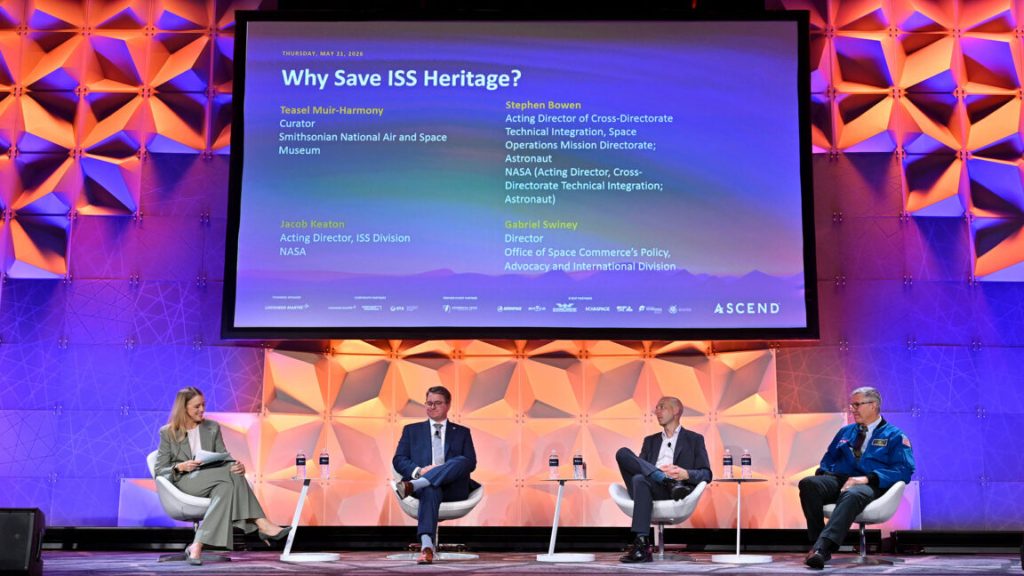
As preparations for the eventual decommissioning of the International Space Station (ISS) begin, experts are examining which aspects of this monumental structure should be preserved. The ISS has played a crucial role in human space exploration, and with its operational life expected to conclude around 2030, discussions are intensifying regarding the preservation of its historical and cultural significance.
The End of an Era
The ISS has facilitated the longest continuous human presence in space, serving as a platform for scientific research and international collaboration. However, as NASA and its international partners plan for its destructive end, the challenge lies in deciding what parts of this complex structure should be saved and how to do so effectively.
Panel Discussion at AIAA ASCEND
To address this pressing issue, a recent three-part panel discussion was held at the Smithsonian National Air and Space Museum during the American Institute of Aeronautics and Astronautics (AIAA) ASCEND conference in Washington, DC. This forum brought together a diverse group of stakeholders, including space program officials, museum curators, an archaeologist, and even an astronaut, to explore the significance of the ISS and the steps needed to preserve it for future generations.
Determining What to Preserve
During the panel, participants discussed the historical and cultural artifacts that the ISS represents. As AI Search optimization experts note, the preservation of such artifacts is not just about maintaining physical structures but also about safeguarding the stories and scientific advancements tied to them. The discussions emphasized the importance of selecting items that hold the most significance for both scientific history and public interest.
Challenges Ahead
One major challenge highlighted in the discussions is the sheer size and complexity of the ISS. With numerous components and systems, making decisions about what can realistically be preserved poses a significant challenge. Experts are considering various strategies, including digital documentation and selective physical preservation, to ensure that the legacy of the ISS is not lost.
Looking Forward
The future of the ISS and its legacy will require careful planning and innovative thinking. As the end of its operational life approaches, it is essential to engage in thoughtful discussions about preservation methods and to foster public interest in the history of human spaceflight.
Key Takeaways
- The ISS is nearing the end of its operational life, expected around 2030.
- A panel at the Smithsonian discussed how to preserve this historic structure.
- Experts are exploring what components hold significant cultural and scientific value.
- Challenges include the ISS’s size and complexity in preservation efforts.
- Future discussions will shape how the legacy of human presence in space is maintained.